Digital Twin in Indian Manufacturing: Use Cases, Benefits & ROI Guide (2026)
Discover how digital twin in Indian manufacturing improves efficiency, reduces downtime, enables predictive maintenance, and drives Industry 4.0 transformation with real-world use cases and ROI insights.
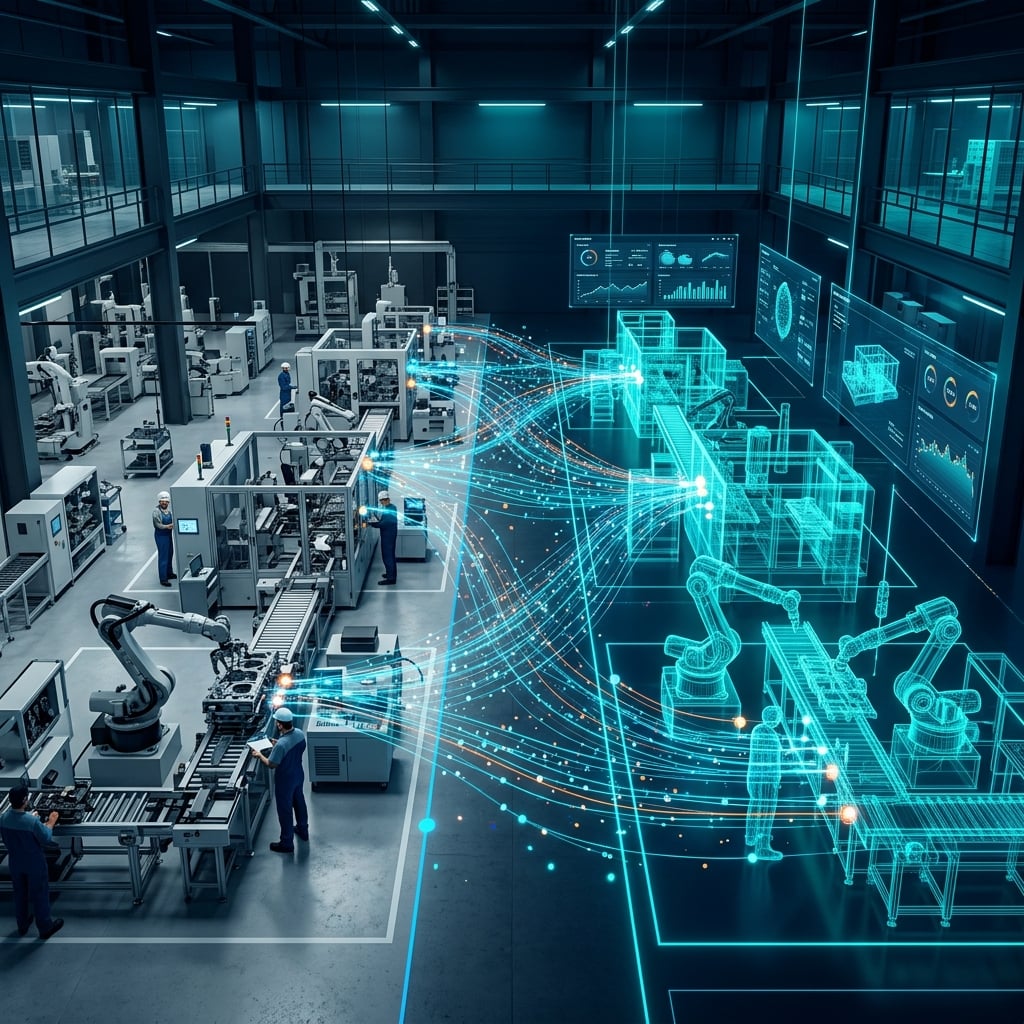
Walk into a steel plant in Odisha or a chemicals facility in Gujarat and you are looking at physical complexity that no human operator can fully track in real time — dozens of interdependent parameters, thousands of sensor readings, and failure modes that develop silently over weeks before they surface as a breakdown. A digital twin is built for exactly this environment: a real-time virtual replica of the physical asset, continuously updated with live data, running simulations that the factory floor cannot.
A digital twin is not a dashboard or a monitoring tool. It is a dynamic software model — physics-based, ML-based, or hybrid — that behaves like the physical asset, predicts how it will behave under different conditions, and alerts operators before something goes wrong. The difference matters: monitoring tells you what is happening; a digital twin tells you what is about to happen and what you should do about it. (Research & Markets, 2023)
*Note: The ROI figures, cost savings, and performance improvements cited in this article are sourced from specific company case studies and industry forecasts. Actual results vary significantly depending on equipment type, data quality, model accuracy, and implementation depth. These figures are indicative benchmarks — not guaranteed outcomes for any given implementation.*
The Case for Digital Twins in India Right Now
Indian factories face a specific set of constraints that make digital twins particularly valuable. A large share of installed equipment is 20-30 years old, running without OEM sensor packages or digital interfaces. Skilled maintenance engineers are scarce and expensive. And margins in sectors like steel, chemicals, and auto components are tight enough that a single major unplanned breakdown can erase a quarter's profit.
The global digital twin market was valued at $28.7 billion in 2024 and is projected to reach $228.6 billion by 2029 — a compound growth rate of ~51% annually. Gartner predicts that over 40% of large manufacturers globally will have deployed digital twins by 2027. In India, a 2025 industry survey found roughly 80% awareness of digital twins among large enterprises — but only around 20% had implemented them beyond a pilot. That gap is the opportunity.
Published Indian case studies show concrete returns. Tata Steel's AI-managed blast furnace — one of the most well-documented DT implementations in the country — achieved a 6-8% reduction in energy consumption and a measurable improvement in EBITDA per tonne. (Gladwin International, 2025). Tata Chemicals' power plant digital twin, built and operated by TCS, delivered approximately $600,000 in annual savings from optimised steam generation and chemical dosing. (TCS, 2024). Larsen & Toubro cut fabrication rework by 25% using process-level twins for welding and heat treatment. Broader Industry 4.0 survey data cites 10-30% OEE improvements and 15-25% downtime reductions at plants with mature DT deployments. NITI Aayog's 2025 advanced manufacturing roadmap describes digital twins as the 'digital backbone' of India's next-generation factories — a rare instance of policy language matching commercial reality.
Digital twin architecture for manufacturing
Most manufacturers assume a digital twin is a single software product they can buy and plug in. It is not. A working DT is a layered architecture where each layer must function reliably before the next one adds value. Understanding this helps manufacturers scope realistic implementations and avoid the most common mistake: building a sophisticated model on top of a weak data pipeline.
The Five Layers
- 1Physical layer — The actual machines, motors, furnaces, or lines — fitted with IoT sensors measuring vibration, temperature, pressure, flow, and current. This is where most Indian manufacturers need to start: retrofitting sensors to legacy equipment that was never designed to be monitored digitally
- 2Connectivity layer — Edge gateways, 5G/IIoT networks, or wired SCADA connections that stream sensor data reliably. Edge devices (like NVIDIA Jetson modules) handle local pre-processing before data is sent upstream, reducing latency and bandwidth costs
- 3Data platform — A historian or cloud data lake (AWS IoT Core, Azure Digital Twins, OSIsoft PI, InfluxDB) that stores both real-time and historical readings. The quality and completeness of this data layer determines how accurate the twin's predictions will be
- 4Virtual model — A software model that replicates the asset's behaviour. In practice this is often a hybrid: a physics-based model (e.g. finite element analysis of thermal stress) combined with ML models trained on historical failure data to catch patterns the physics model doesn't capture
- 5Visualisation & integration — Operator dashboards, AR interfaces, and API connections that push twin outputs into MES, ERP, and PLM systems. A DT that generates alerts no one can act on is worthless — integration with operations is what converts model outputs into business outcomes
Tech Mahindra's 2025 Centre of Excellence uses NVIDIA Omniverse to build photo-realistic factory twins — enabling engineers to simulate plant layout changes, production flows, and equipment placement in 3D before any physical work begins. (Tech Mahindra, 2025). For most Indian manufacturers, however, the starting point is simpler: a single critical machine, an ML model trained on its sensor history, and an alerting system connected to the maintenance team's phones.
Security must be designed in from the start, not added later. A DT connected to live shop-floor equipment creates new attack vectors. The minimum baseline: encrypted device communication (MQTT-TLS), PKI-based device authentication, and hard network segmentation between operational technology (OT) and IT systems. The 2021 Oldsmar water treatment hack — where an attacker remotely adjusted chemical dosing levels — is a reminder of what happens when connected industrial systems aren't properly isolated.
Digital twin use cases in manufacturing: Fastest ROI
Not all digital twin applications have the same payback timeline. Based on published Indian implementations and global industry data, these are the five highest-ROI entry points — roughly in order of how quickly most manufacturers see returns:
1. Predictive maintenance digital twin India — Fastest Payback
This is where almost every successful DT programme in India starts. A twin continuously monitors vibration signatures, bearing temperatures, motor current draw, and lubrication pressure on critical equipment. ML models — trained on historical failure data — learn what 'normal' looks like and flag deviations weeks before they cascade into a breakdown. The financial case is straightforward: a single avoided breakdown on a critical line can save more than the cost of the entire pilot.
The value is especially high in Indian factories running old machinery. Without OEM fault libraries or detailed maintenance records, a data-driven twin often becomes the first systematic record of how a machine actually behaves — and fails. Over time, the model improves as it accumulates more labelled failure events, compounding its prediction accuracy.
2. Process Optimisation & Energy Reduction
Energy is a major cost in steel, chemicals, cement, and glass manufacturing. A process-level digital twin continuously adjusts operational parameters — furnace temperatures, injection rates, reaction pressures, conveyor speeds — to keep the plant running at peak efficiency rather than at a 'safe' conservative setting. Tata Steel's AIRO programme demonstrated this clearly: an autonomous blast furnace twin adjusting hot-blast temperature, burden distribution, and pulverised coal injection rates achieved 6-8% energy savings that would have been impossible to sustain manually. At a steel plant burning hundreds of crores in fuel annually, that percentage translates to tens of crores in recurring savings.
3. Quality Control & Defect Prevention
A process twin monitors the parameter envelope within which a product will meet specification. When a variable drifts — say a furnace temperature drops 15 degrees below target, or a coolant flow rate falls — the twin flags the affected batch before it reaches the inspection gate, allowing the team to investigate and correct rather than scrap finished product. Larsen & Toubro applied this to complex welding and heat treatment operations where manual inspection was expensive and post-weld rework was a significant cost. The result was 25% less rework and more consistent module delivery. For compliance-heavy sectors (pharmaceuticals, food, automotive), this approach also generates the digital audit trail that regulators require.
4. Design Validation & Virtual Commissioning
Before a new production line is commissioned or a process change is implemented, a digital twin lets engineers simulate the change under a range of conditions — different throughput levels, material variations, ambient temperature — and validate performance without production risk. Commissioning errors on major capital projects can cost crores in delays and rework; catching them in simulation is orders of magnitude cheaper. This is particularly valuable for capital-intensive sectors like semiconductors, specialty chemicals, and advanced auto components where any new line is a multi-year investment.
5. Operator Training via Simulation
High-hazard environments — chemicals, steel, oil & gas — cannot afford on-the-job learning for emergency procedures. A digital twin allows new operators to practise complex changeovers, emergency shutdowns, and abnormal condition responses on the virtual plant, with no risk to equipment or personnel. As India's manufacturing workforce expands to meet export targets, this application will grow in importance: a simulation-based training programme scales far more cheaply than instructor-led training and delivers more consistent outcomes.
Indian Company Case Studies
Tata Chemicals — Power Plant Digital Twin
Tata Chemicals operates energy-intensive chemical plants where power generation efficiency directly determines product cost. The company partnered with TCS to deploy a physics-based and ML digital twin across its boilers and carbonation towers — two of the most parameter-sensitive systems in a fertiliser plant. The twin continuously optimised steam pressure, temperature, and chemical dosing rates based on live sensor readings and demand forecasts. The published outcome: approximately $600,000 in annual cost savings, alongside higher product yield and lower energy consumption per unit. The pilot was launched in 2023 and reached full operational status in 2024. (TCS case study)
Tata steel digital twin case study — Autonomous Blast Furnace
Tata Steel's AIRO (AI for Reimagining Operations) programme is one of the most technically ambitious digital twin deployments in Indian manufacturing. The blast furnace twin operates in closed-loop mode: AI models autonomously adjust hot-blast temperature, coke rate, burden distribution, and pulverised coal injection rates in real time — decisions that previously required experienced operators and were made at intervals, not continuously. The result is tighter control of an inherently chaotic process. Documented outcomes include a 6-8% reduction in energy consumption and a reported +15% improvement in EBITDA per tonne — among the most specific and credible DT ROI figures publicly available from an Indian manufacturer. (Gladwin International, 2025)
Larsen & Toubro — Fabrication Process Twin
L&T's heavy engineering division manufactures large structural and pressure components where welding and heat treatment quality is critical — and rework is extremely expensive. The company implemented digital twin modelling of its fabrication processes, simulating thermal cycles and residual stress distributions before physical execution. Engineers could identify process settings likely to produce distortion or sub-spec welds — and correct them in the model before running the job. The outcome: 25% reduction in rework and more consistent delivery of engineered modules to specification. The programme has been active since 2021, making it one of the longer-running documented DT deployments among Indian manufacturers.
Tech Mahindra — Digital Twin Centre of Excellence
Rather than deploying a DT for internal operations, Tech Mahindra built the capability to deploy them for clients. Its Digital Twin CoE, launched in 2025 and built on NVIDIA Omniverse, creates photo-realistic, physics-accurate virtual replicas of client factories. The platform supports real-time simulation, AI-driven process analysis, and AR-based operator interfaces — enabling clients in automotive, aerospace, and heavy manufacturing to test layout changes, simulate production ramp-ups, and train operators without touching the physical plant. (Tech Mahindra, 2025)
Government Support: Offsetting the cost of digital twin implementation in India
India's Industry 4.0 policy framework offers several routes to offset the cost of digital twin adoption. The key is knowing which scheme applies to your company size, sector, and technology need — and applying through the right channel:
SAMARTH Udyog Bharat 4.0
Launched in 2019 by the Ministry of Heavy Industries, SAMARTH established four Industry 4.0 Centres of Excellence — at IISc Bengaluru, IIT Delhi, CMTI Bengaluru, and NITK Surathkal. These 'Samarth Hubs' give manufacturers, including SMEs, access to AR/VR labs, simulation platforms, 3D printers, and IoT testbeds without the capital cost of building in-house infrastructure. Engineers can prototype digital twin solutions, test IoT integrations, and get hands-on training in a real industrial environment. Over 5,000 engineers have passed through Samarth programmes as of 2026. (PIB)
RAMP Project (2022-27)
The World Bank-backed Raising and Accelerating MSME Performance programme co-funds Industry 4.0 technology adoption for approximately 5.5 lakh MSMEs, with ₹250 Cr earmarked specifically for technology upgradation. Eligible manufacturers in registered clusters can apply for matching grants covering sensors, edge compute hardware, software licences, system integration, and staff training — all directly applicable to a digital twin pilot. Applications go through nodal agencies (NIMSME or local MSME Development Institutes) and are assessed on a per-project basis. (MSME Ministry)
IndiaAI Mission (2024-29)
The ₹10,372 crore IndiaAI Mission, approved in March 2024, is building public GPU compute infrastructure that manufacturers and startups can access at subsidised rates through a public portal. For digital twin developers and deployers, this means running computationally intensive simulation models — finite element analysis, ML training, real-time 3D rendering — without the capital cost of on-premise GPU clusters. The mission also funds the FutureSkills programme, which covers AI and simulation skills relevant to DT engineering teams. (PIB)
Additional Support Schemes
- MSME Champions Scheme (2020-26) — Cluster-based funding for digital, lean, and innovative manufacturing upgrades including IoT and DT projects (PIB)
- CLCSS — 15% government subsidy (up to ₹1.5 lakh) on bank loans for technology upgrades — applicable to sensor and edge hardware purchases
- PLI Schemes — Auto, electronics, and specialty chemicals PLI beneficiaries often receive technical assistance that includes digital infrastructure upgrades
- State incentives — Tamil Nadu, Karnataka, and Gujarat offer capital subsidies and interest subvention specifically for Industry 4.0 modernisation; check local MSME Development Corporations for current call-for-applications
To access RAMP or Champions scheme grants, companies must be registered on the Udyam portal with a valid MSME Udyam certificate and be GST-compliant. Calls for digitisation proposals are typically announced on PIB and Ministry of MSME websites — set up alerts so you don't miss application windows.
Implementation Roadmap: A Practical Phased Approach
Every major successful DT implementation in India has followed the same logic: start with a single asset where the cost of failure is highest, prove the model works, then scale. The temptation to 'boil the ocean' — building a factory-wide twin from day one — is the most common reason DT projects fail before they deliver value. Here is a realistic phased roadmap to ensure no critical gaps are left in your execution:
- 1Select one critical asset — Choose the machine or process where an unplanned stoppage costs the most, or where quality failures are most expensive. The higher the stakes, the faster the payback justifies the investment. A blast furnace, a critical CNC machining centre, or a boiler are typical starting points
- 2Instrument it properly before building the model — Attach IoT sensors for the parameters most predictive of failure: vibration (for rotating equipment), temperature (for thermal processes), current draw (for motors), pressure drop (for flow systems). The model is only as good as the data feeding it
- 3Start with a simple model, validate it rigorously — An ML anomaly detection model trained on 6-12 months of historical data is a practical starting point. Before acting on its outputs, validate: did it correctly flag known past failures? False-positive rate matters — too many false alarms will kill operator trust
- 4Run in observation mode for 4-8 weeks — Let the twin generate predictions in parallel with normal operations without triggering any actions. This builds operator confidence, surfaces edge cases the model didn't anticipate, and establishes a baseline for measuring impact once you go live
- 5Connect outputs to operations — Once validated, wire twin alerts into the maintenance scheduling system, operator consoles, or SCADA. Track OEE, unplanned downtime hours, and energy per unit before and after. These baselines are essential for justifying scale-up budget
- 6Scale incrementally, not all at once — Roll the validated model to similar machines, then adjacent processes, then additional lines. Build a centralised DT platform (cloud or on-premise) to host multiple twins under consistent governance
- 7Precautionary note — Published ROI benchmarks (10-30% OEE gain, 15-25% downtime reduction) are from best-in-class implementations at large, well-instrumented plants. Your results will depend on your baseline data quality, equipment age, and how rigorously you follow the process above. Treat these numbers as targets, not forecasts
Challenges That Derail Digital Twin Projects
Digital twin projects in Indian manufacturing fail for predictable reasons. Knowing them in advance makes them manageable:
- Data gaps on legacy equipment — Equipment installed before the IoT era generates no data. Retrofitting sensors is essential but adds cost and sometimes requires production downtime. Start with the most critical machines and instrument them properly; don't try to build a twin from incomplete or unreliable data
- Model accuracy vs. operator trust — A twin that generates too many false positives loses operator trust quickly. The observation mode step in the roadmap exists precisely to calibrate model sensitivity before it drives real decisions. Invest in validation before go-live
- Legacy system integration — Connecting DT outputs to existing SCADA, MES, or ERP systems is technically the hardest step. Choose DT platforms that support industrial protocols (OPC-UA, MQTT) and have pre-built connectors for common MES/ERP vendors. Custom integrations add time and cost
- Skill gaps — the biggest bottleneck — Effective DT projects need engineers who understand both the manufacturing process and data science. This combination is rare in India, where the talent pool skews either to domain experts or software engineers, rarely both. Partnering with specialist integrators is usually more practical than hiring
- Cybersecurity — often underestimated — Connecting operational technology to cloud systems fundamentally changes the attack surface. Network segmentation (OT/IT separation), encrypted device communication, and regular vulnerability assessments are non-negotiable — not optional enhancements
- Change management — The most technically sophisticated twin fails if operators don't trust it or managers don't act on its outputs. Start with use cases that address pain points the team already feels (reducing breakdown alarms is usually the most relatable). Early wins build the internal credibility needed to scale
What Does a Digital Twin Cost — and What is the ROI?
Cost ranges vary enormously depending on the scope, complexity, and existing infrastructure. Based on published cases and industry consulting estimates:
- Small pilot (1 machine, ML anomaly detection model) — ₹5-20 lakh, covering sensor retrofitting, edge compute, and model development. This is the right starting point for most Indian MSMEs
- Line-level twin (full production line with MES integration) — ₹50 lakh - ₹2 crore, depending on line complexity and the number of systems the twin needs to integrate with
- Factory-wide digital twin — ₹5-20 crore or more for large, complex plants with multiple interdependent systems. Enterprise-scale implementations with AR/VR interfaces and full physics-based modelling can exceed this range
- ROI benchmark — A 10% reduction in unplanned downtime at a plant generating ₹100 Cr/year saves ₹5-10 Cr annually. Most well-scoped pilot implementations recover their investment within 12-24 months. Tata Chemicals' $600K/year saving against a plant-level implementation cost is a representative example of this payback structure
RAMP matching grants and CLCSS subsidies can offset 15-50% of pilot costs for eligible MSMEs, significantly improving the investment case. Factor these into your business case before deciding on scope.
How EMERSIT Helps
The gap between understanding that a digital twin would be valuable and having one running reliably is almost entirely an execution problem — not a technology problem. Selecting the right assets, choosing sensors that will hold up in an industrial environment, building models that are accurate enough to trust and simple enough to maintain, and connecting outputs to the systems operators already use: this is where most implementations stall.
EMERSIT designs and deploys end-to-end digital twin systems for Indian manufacturers — from sensor selection and edge infrastructure through model development, SCADA/MES integration, operator training, and ongoing model refinement. The focus is always on a specific, measurable outcome: less unplanned downtime, lower energy cost per unit, fewer defects reaching the quality gate, faster commissioning of new lines.
Looking to implement digital twin technology in your manufacturing operations?
EMERSIT helps manufacturers build scalable Industry 4.0 and smart manufacturing solutions with real-time monitoring, predictive analytics, and operational intelligence.
Book a ConsultationFrequently Asked Questions
Q1. What is a digital twin in manufacturing?
A real-time virtual replica of a physical asset or process, continuously updated with live sensor data. Unlike a monitoring dashboard, a digital twin actively simulates how the asset will behave — enabling predictive maintenance, process optimisation, quality control, and 'what-if' scenario testing without touching actual equipment.
Q2. Which Indian companies have deployed digital twins with documented results?
Tata Chemicals ($600K/yr savings from a power plant twin built by TCS), Tata Steel (6-8% energy savings and +15% EBITDA/tonne from an autonomous blast furnace twin), Larsen & Toubro (25% rework reduction in heavy fabrication), and Tech Mahindra (Omniverse-based DT platform for manufacturing clients). Mahindra & Mahindra has run automotive assembly pilots since 2024 with reported downtime reductions, though exact figures are not publicly released.
Q3. Can MSMEs afford to implement a digital twin?
Yes, if scoped correctly. A single-asset pilot with ML anomaly detection can be implemented for ₹5-20 lakh — within reach of most mid-sized manufacturers. RAMP project grants can cover up to 50% of costs for eligible MSME cluster members, and CLCSS provides a 15% subsidy on technology upgrade loans. Cloud-based simulation platforms eliminate the need for expensive on-premise hardware.
Q4. What government schemes support digital twin adoption?
SAMARTH Udyog Bharat 4.0 (Industry 4.0 test-beds at IISc, IIT Delhi, CMTI, NITK — free to access for manufacturers), RAMP Project (MSME technology grants with ₹250 Cr for Industry 4.0), IndiaAI Mission (subsidised GPU compute), MSME Champions Scheme (cluster-based digital upgrade funding), and CLCSS (15% loan subsidy for technology investments).
Q5. How long does a digital twin pilot take to show results?
A well-scoped single-asset pilot typically takes 3-6 months from sensor installation to validated predictions. Running in observation mode for 4-8 weeks before go-live is strongly recommended. Full factory-wide rollout across multiple systems is typically a 12-24 month programme. The Tata Chemicals implementation went from pilot to full operation in approximately 12 months.