How AI is Transforming Indian Manufacturing: Benefits, Use Cases & Government Incentives
Artificial Intelligence (AI) is rapidly transforming the Indian manufacturing sector. From predictive maintenance to smart factories, AI in Indian manufacturing is helping companies improve efficiency, reduce downtime, and automate operations. Learn about Industry 4.0 adoption, MSME AI adoption India, and government schemes for AI in manufacturing that are helping manufacturers stay competitive.
AI adoption in manufacturing is accelerating across India. By FY2023-24, about 28% of manufacturing firms were already using AI technologies, with wider enterprise-level adoption at approximately 48% (Economic Times, 2024). Across all sectors, 87% of Indian enterprises now use some form of AI in at least one function (NASSCOM AI Adoption Index, 2025).
MSMEs contribute roughly 35.4% of India's manufacturing output — so AI-driven efficiency gains in this segment could be transformative at scale. NITI Aayog's 2025 report projects AI could add $85-100 billion in manufacturing productivity and $1.7 trillion to India's GDP by 2035.
*Note: The statistics, ROI figures, and cost projections cited in this report are based on specific industry studies and historical data. Actual results in manufacturing are highly variable; they depend on individual equipment, data quality, and operational scale, and should be viewed as benchmarks rather than fixed outcomes.*
Key Use Cases of AI in Indian Manufacturing
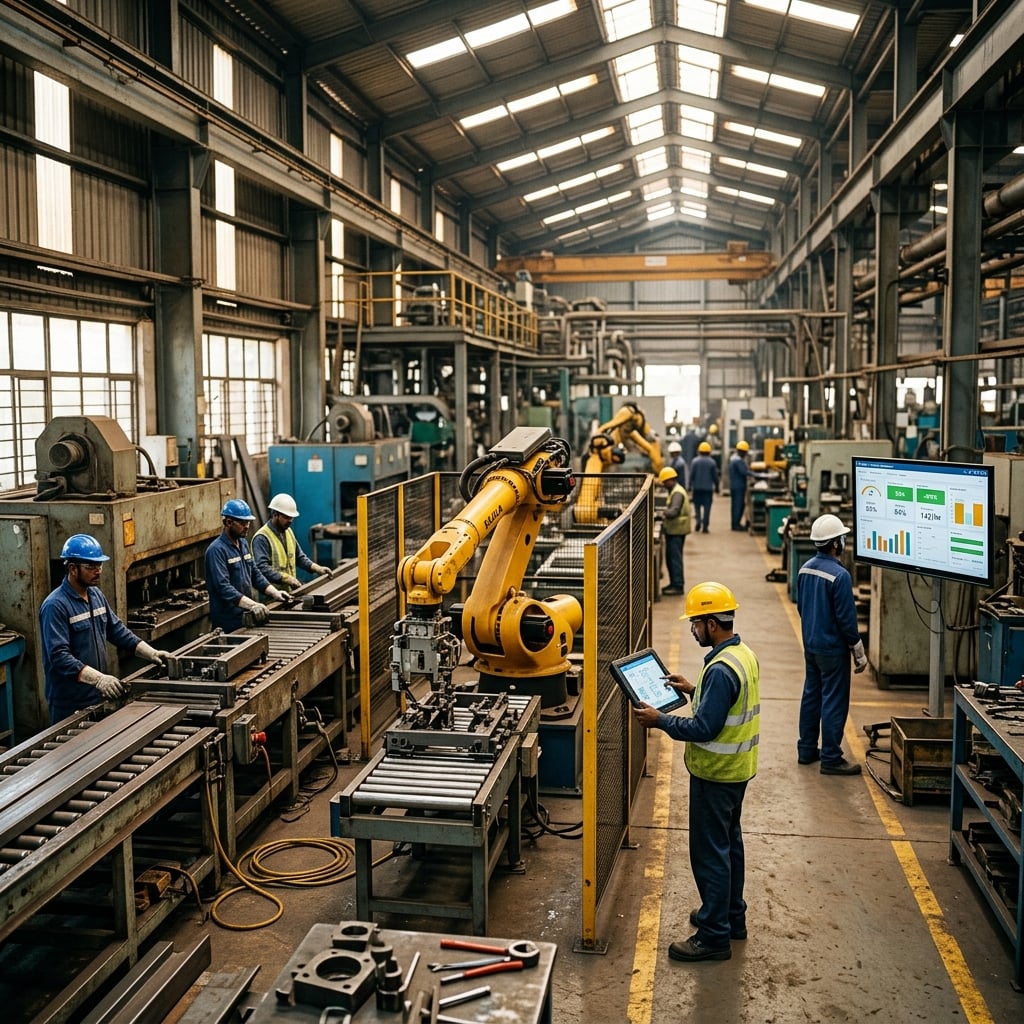
The highest-ROI applications are not advanced robotics — they are practical, data-driven use cases already running at Indian plants:
AI predictive maintenance India
AI helps detect machine failures before they occur, reducing downtime and maintenance costs. Fitting IoT sensors on critical equipment and running ML models on that data is the most common first step for manufacturing automation in India. Tata Metaliks (a Tata Steel subsidiary) deployed this on sinter plant gearboxes and achieved a 28% reduction in scheduled inspections and zero downtime from failures post-deployment, according to a SenseGrow case study. Mahindra & Mahindra similarly reports 'significantly reduced unplanned downtime' at its auto plants after deploying ML-based predictive maintenance on robots and engines since 2023 (ET Enterprise AI, 2025). See how we implement Asset Management Systems to drive these results.
AI-Powered Quality Inspection
Computer vision systems inspect every unit at line speed, catching what manual QC misses. An IMARC Group analysis of Indian plants cites 12.5% reduction in material costs, 66% fewer defects, and ~20% faster cycle times at leading factories. Robro Systems' Kiara vision platform, deployed at an Indian rope and bag manufacturer in 2022, reduced defect rates by ~50% and raised production efficiency by ~20% through automated weaving-fault and color-mismatch detection. This is a core part of modern Traceability & Smart Manufacturing.
Tata Motors introduced computer-vision AI in 2023 to inspect car components for micro-cracks and surface flaws. The company reports measurable drops in rework and faster QA cycles — alongside AI-driven inventory optimisation based on real-time demand and supply data (IJRPR, 2025).
Supply Chain Optimization
The most advanced implementations run hundreds of AI models simultaneously across a plant. Tata Steel has done this since 2018 — 260+ AI models controlling blast-furnace parameters, casting lines, quality gates, and energy usage. The outcome: ~90% first-pass yield and $1.4 billion saved over a few years, roughly a 10× return on AI investment. Tata Steel was recognised as a WEF Global Lighthouse in 2023 for this programme.
Production Planning
AI analyzes real-time data to optimize manufacturing processes. Godrej & Boyce deployed 'Factory360' in 2024 — an in-house AI/IoT platform monitoring equipment health and optimising line schedules. A Deloitte India case study projects ~$25 million in cost savings over 3 years from reduced breakdowns and scrap. Rollout to additional plants was underway by 2025.
Government schemes for AI in manufacturing
India has launched several funded programmes that directly lower the cost and risk of technology adoption for manufacturers, especially driving MSME AI adoption India:
IndiaAI Mission (2024-29)
In March 2024, the Cabinet approved an ₹10,372 crore (~$1.2 billion) IndiaAI Mission. Key components include building public AI compute infrastructure (10,000+ GPUs), developing indigenous foundation models, and funding startups and skills via the FutureSkills programme. For manufacturers, this opens up subsidised access to high-end cloud compute and grants for building industry-specific AI tools. Our Compliance Advisory team helps navigate these opportunities.
RAMP Project (2022-27)
Raising and Accelerating MSME Performance is a World Bank-supported programme co-funding Industry 4.0 technology adoption for ~5.5 lakh MSMEs. Eligible manufacturers in clusters can obtain matching grants for sensors, cameras, and digital platforms, along with consulting and training support — managed jointly by the MSME Ministry and State governments.
Champions Scheme & ZED Certification
The MSME Champions Scheme (2021-26) covers Quality/Lean, Innovation/IPR, and technology upgrades. MSMEs achieving ZED (Zero Defect, Zero Effect) certification receive interest-rate concessions and processing-fee waivers from partner banks. Over 500,000 MSMEs are enrolled in Champions clusters as of 2025.
SAMARTH Udyog Bharat 4.0
Launched by the Ministry of Heavy Industries, this initiative established Industry 4.0 test-beds and training centres at IISc Bengaluru, IIT Delhi, CMTI Bengaluru, and NITK Surathkal. These Samarth Hubs let manufacturers — including SMEs — experiment with AI, robotics, and additive manufacturing without heavy upfront investment. Over 5,000 engineers have been trained through Samarth as of 2026.
Credit & Subsidy Schemes for MSMEs
- CLCSS — 15% government subsidy (up to ₹1.5 lakh) on bank loans for technology upgrades
- CGTMSE — Collateral-free loans up to ₹2 crore for small businesses
- PMEGP — Subsidised credit for new manufacturing ventures
- Lean Manufacturing Scheme — Grants for efficiency consultants
- PLI Schemes — Production-linked incentives for electronics and pharma that indirectly encourage AI-equipped factories
A Practical Roadmap for Getting Started
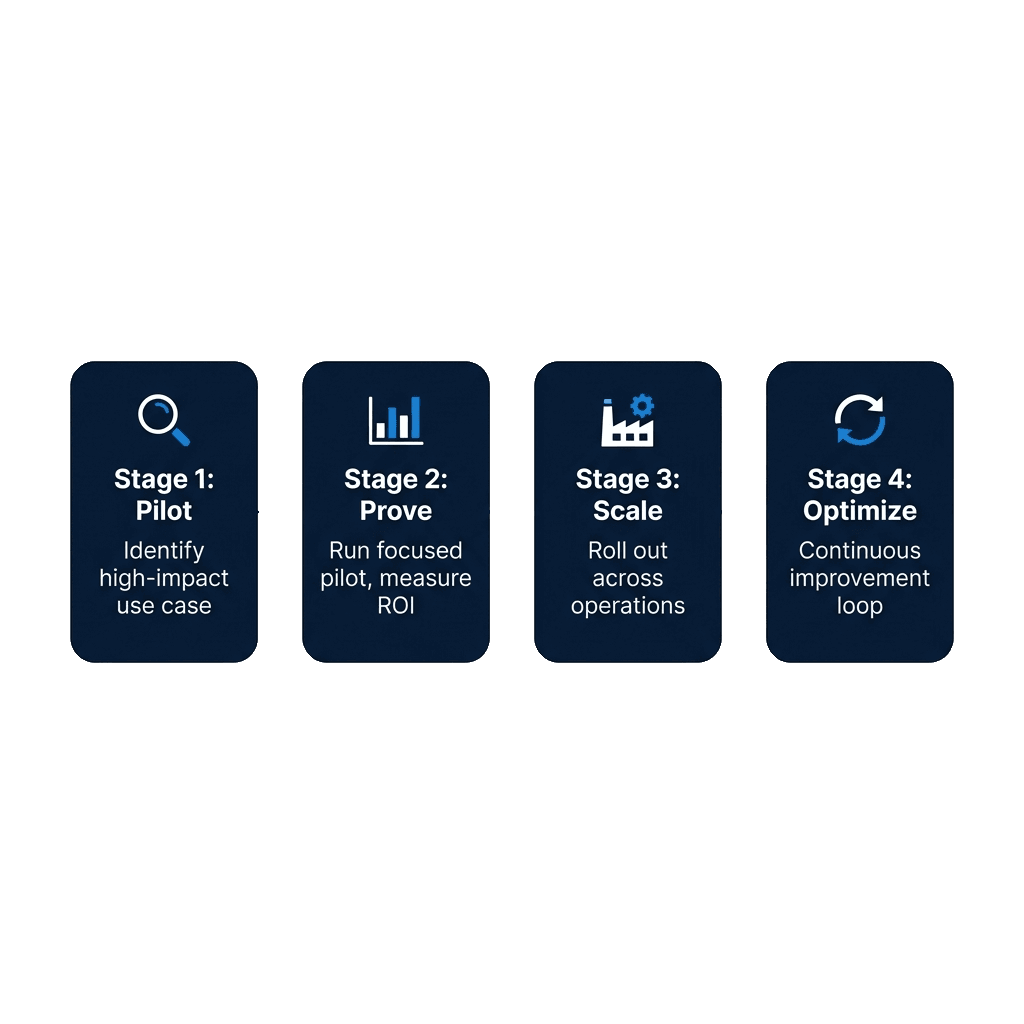
Every major success story in this article followed the same basic sequence: start narrow, prove value, then scale. To ensure no strategic gaps are left in your execution, follow this comprehensive 6-step roadmap:
- 1Identify one high-impact problem — Start where data already exists: machine sensor logs for predictive maintenance, camera feeds for quality, or ERP records for demand forecasting
- 2Run a focused 2-6 month pilot — Prove ROI on one line or one machine. Basic cloud AI pilots start around $5,000; industrial-scale implementations typically cost $50K-$100K
- 3Invest in data infrastructure first — IoT sensors, cameras at inspection points, and a connected MES/ERP platform. AI models are only as good as the data feeding them
- 4Define KPIs before launch, not after — OEE, defect rate, unplanned downtime, and cost-per-unit are the clearest metrics
- 5Scale based on results — Roll proven solutions to additional lines or plants. Use RAMP cluster grants and SAMARTH training to offset costs
- 6Close the 'Data-to-Action' Gap (Precautionary) — Ensure your shop-floor operators are trained to act on AI alerts in real-time. The most dangerous gap in any roadmap is having a system that identifies failures without a human protocol to fix them. No implementation is complete without a defined response loop.
Challenges of AI Adoption in Indian Manufacturing
Despite the immense potential, manufacturing SMEs in India face significant obstacles to AI adoption. The key challenges include:
- Data quality and availability: Many SMEs lack the sensors, data infrastructure, and standardized data collection practices necessary for training effective AI models.
- Skill gaps: There is a shortage of personnel with the right skills to implement, manage, and interpret AI systems, particularly in smaller organizations.
- Cost of implementation: The initial investment in AI technology and the cost of integrating it with existing legacy systems can be prohibitive for many SMEs.
- Legacy system integration: Connecting new AI solutions with older manufacturing equipment and software systems presents significant technical challenges.
- ROI measurement — Agree on baseline metrics before the pilot starts, not after results come in
- Cybersecurity — Connected shop-floor systems expand the attack surface. Implement network segmentation and access controls from day one
The Future of AI in Indian Manufacturing
The trajectory is clear: AI is moving from isolated pilots to plant-wide, always-on intelligence. Several converging trends will define the next phase of AI in Indian manufacturing over the coming decade.
Smart factories at scale. Early adopters like Tata Steel and Godrej & Boyce have proven that AI-managed production — hundreds of models running simultaneously across quality, energy, maintenance, and scheduling — delivers compounding returns. As sensor costs fall and edge compute becomes more accessible, this model will move from flagship plants to mid-sized factories and eventually to MSME clusters. The government's SAMARTH Hubs and IndiaAI Mission GPU infrastructure are specifically designed to accelerate this shift.
Deeper automation of decision-making. Today's implementations primarily alert human operators; tomorrow's will close the loop autonomously — adjusting furnace parameters, rerouting production schedules, and reordering raw materials without manual intervention. Tata Steel's autonomous blast furnace twin is an early example of this trajectory. As trust in AI-driven decisions grows and regulatory frameworks mature, autonomous manufacturing will expand beyond process industries into discrete manufacturing and assembly.
Digital transformation as a competitive requirement. Global OEMs and export markets are increasingly mandating digital traceability, real-time quality documentation, and sustainability reporting from their Indian suppliers. Manufacturers that have embedded AI into their operations will meet these requirements as a byproduct of their existing systems; those that haven't will face growing compliance costs and risk losing contracts. The PLI schemes across electronics, auto components, and specialty chemicals are already linking incentives to digital capability.
AI-native workforce development. India's demographic advantage — a young, technically trainable workforce — becomes a strategic asset as manufacturing AI scales. Programmes like NASSCOM FutureSkills, Samarth training centres, and corporate academies (Tata Motors, Mahindra) are building a pipeline of engineers who understand both shop-floor realities and data science. Over the next five years, the gap between AI talent supply and demand in manufacturing is expected to narrow significantly, making implementation faster and less dependent on external consultants.
The manufacturers investing in AI infrastructure today — even at pilot scale — are building the operational foundation that will define competitiveness in Indian manufacturing through 2030 and beyond. The question is no longer whether to adopt AI, but how quickly and how strategically.
How EMERSIT Supports AI Adoption in Manufacturing
Most manufacturers know what problem they want to solve. The harder challenge is execution: connecting shop-floor data to AI models, integrating outputs with MES and ERP, ensuring traceability and compliance, and scaling reliably across plants.
EMERSIT builds end-to-end smart manufacturing systems for Indian manufacturers — from sensor infrastructure and predictive maintenance to computer-vision quality inspection and regulatory compliance. Our focus is always on measurable outcomes: less downtime, fewer defects, better yield.
Ready to explore AI for your facility?
Looking to implement AI technology in your manufacturing operations?
EMERSIT helps manufacturers build scalable Industry 4.0 and smart manufacturing solutions with real-time monitoring, predictive analytics, and operational intelligence.
Book a ConsultationFrequently Asked Questions
Q1. What percentage of Indian manufacturing firms use AI?
As of FY2023-24, approximately 28% of manufacturing firms had adopted AI. Broader enterprise-level adoption (across any function) stands at 48-87% depending on the methodology used.
Q2. Which Indian companies are leading in manufacturing AI?
Tata Steel (260+ AI models, $1.4B savings, WEF Global Lighthouse 2023), Godrej & Boyce (Factory360, $25M projected savings), Mahindra & Mahindra (predictive maintenance), Tata Motors (computer-vision QC), and Tata Metaliks (zero downtime via sensor-based maintenance).
Q3. What government schemes support AI adoption for MSMEs?
IndiaAI Mission (₹10,372 Cr for AI infrastructure), RAMP Project (World Bank-backed MSME grants), Champions Scheme (ZED certification benefits), SAMARTH Udyog Bharat 4.0 (Industry 4.0 training hubs), and CLCSS (15% subsidy on technology upgrade loans).
Q4. What does an AI pilot in manufacturing typically cost?
Cloud-based pilots start around $5,000. Industrial-scale implementations run $50K-$100K. Full-plant automation can exceed $500K. Government subsidies and RAMP cluster grants can significantly reduce these costs for MSMEs.
Q5. What are the biggest implementation challenges?
Poor data quality from legacy equipment, AI talent shortages, integration with existing MES/ERP/SCADA systems, and difficulty establishing baseline metrics for ROI. A pilot-first, narrow-scope approach manages all of these.